
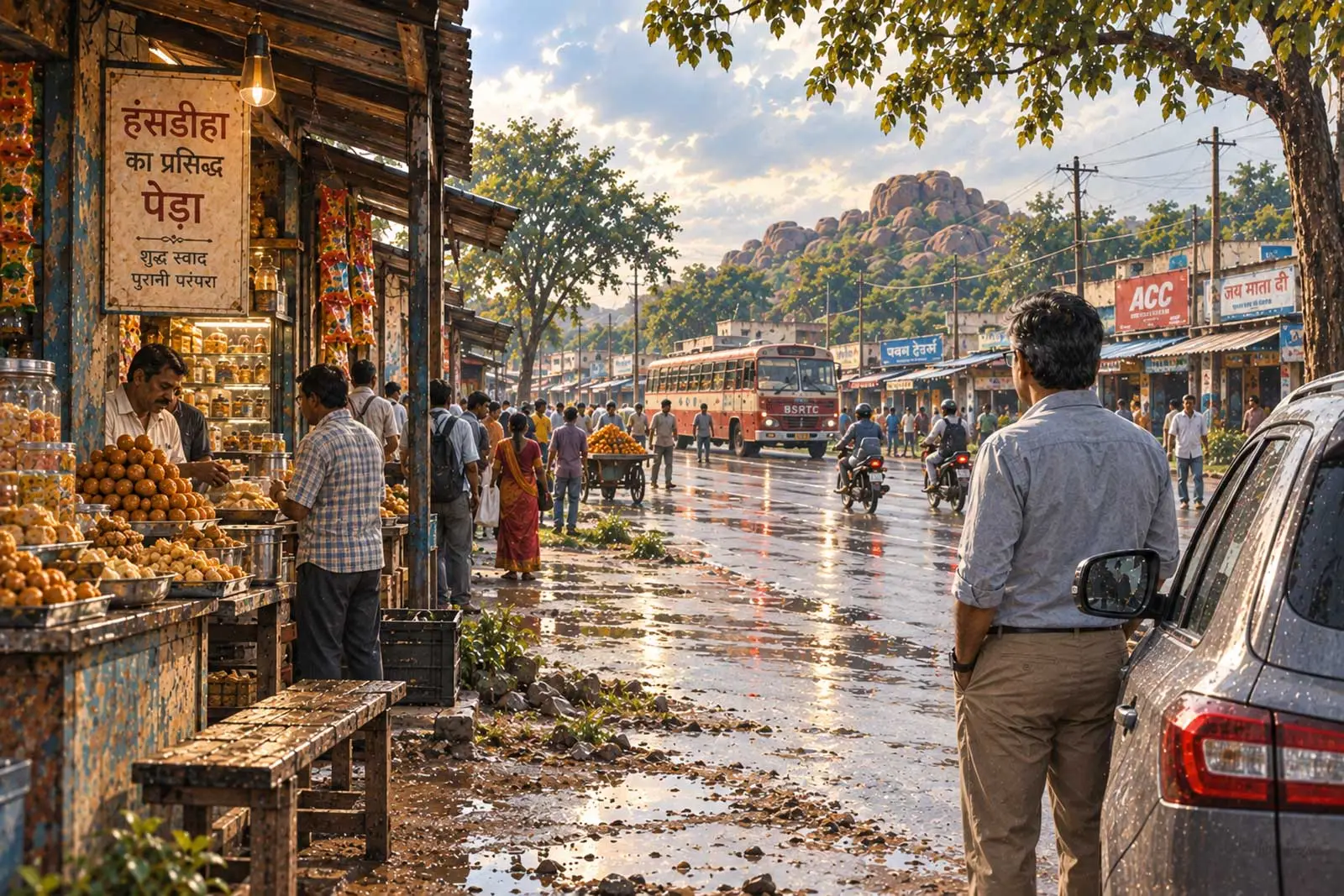
“...ten pedas in one rupee,” my wife said as she stepped out of the car at Hansdiha. “Twelve, even thirteen, if you knew how to haggle.” She shut the door before I could respond.
I watched her cover herself from the drizzle with her purse held over her head, take a long step over the bent guardrail, and tiptoe to the sweet shop.
“They were twice the size of a 50-paise coin,” I said as she disappeared beneath the canopy and stood at the counter. “The peda sellers would surround the bus even before the dust from its wheels had settled down.”
“Seems like a story from another world,” the elder daughter said.
“Ek rupayya mein 20, ek rupayya mein 20,” they would shout, flailing with one hand while balancing the tray full of pedas on the other.
“But...!”
“Pachees — 25 doge?” a head would pop out from the window.
“20,” he would say.
“25.”
“22.”
“23.”
“Jaldi — quick,” he would say, trying to sound irritated.
“He would then stack the pedas, one on top of the other, wrap them in a sheet of newspaper and pass the cylindrical packets into the hand that held the note.”
“You mean they used newspaper to wrap pedas!” our younger daughter said. “Yuck! That’s so unhealthy.”
“We didn’t have plastic bags then.”
“No polythene.”
“Not even water bottles.”
“Then how did people drink water?”
“You asked for it.”
“Free of cost.”
“Yes, brought straight from the well. Saal leaves were also used. They crafted a dona, stitching the leaves with thin twigs, and even served tadi in it.”
“Tadi?”
“Yes, tadi. Toddy, you know.”
“Liquor,” the elder daughter said, making a face.
“No, tadi,” I said. “I will show you the photos.”
“Yes, in a village weekly hatia. About five years ago. We were returning from Baba Shumeshwar Nath Temple,” the elder daughter said. “We will be driving by it.”
“A Shiva temple established by two rakshas — demons…” she said, turning to her sister. “Hai na, papa?”
“This is a land of demons — Ravana, Shumbha, Nishumbha — all worshipping their deity, Lord Shiva,” I replied.
“Interesting place. Interesting stories!” she said.
Even before I could say anything, a movement outside distracted me. My wife’s face peered through the frosted glass, gesturing me to unlock the door. She had covered her head with her dupatta.
“There were not many sweets,” she said as she wiped herself. “I bought soanpapdi,” she continued, keeping the cardboard box on her lap.
“I thought peda sellers would come running towards our car,” I said to my wife.
“It’s drizzling. And quite late,” she replied.
“Maybe they are all home,” I said.
“Maybe they are with their families enjoying the mela,” my wife added.
“Didn’t the shop have pedas?” I asked.
“No.”
“Mumma, you had said 10 pedas in one rupee but papa says 20!” The younger daughter got her chance.
My wife glanced at me.
“Beta, I am older than your mamma,” I said. “From 20 to 10 to 5 — I have seen it all.”
“Uske baad?” It was the elder daughter.
“After that?” I paused and looked outside. The rain had slowed down. Most of the shops, including the one known for its moorhi-ghughni, were closed. I once had tea here.
“Your Dadaji bought a car.”
They smiled.
I didn’t.
“And once we had a car…” I looked at the nearly deserted bus stop through the misty glass, “…we stopped stopping at Hansdiha.”
Saying this, I pressed the start button, shifted the lever into drive mode, and lifted my foot from the brake.
“Bus or car — what would you prefer now?” the younger daughter asked.
“Maybe bus. Maybe car. Maybe both. I can’t say,” I said. “Car brings freedom. The bus brings people, the heat, dust and grime, and stories. In a car you are secluded from the masses. In a bus you are one of them.”
As the car rolled forward, I pressed the accelerator.
“You know,” I said as Hansdiha receded in the rear-view mirror. “When I was a kid and grown-ups would ask me what I wanted to do in life, what did I say?”
I did not wait for them to complete their yeses.
“I would become a bus driver.”
They laughed. I also joined them. But mine wasn’t as hearty as theirs.
Cutting through the Santhal Pargana’s baked laterite earth, the road rose and fell. Often it would take giant swoops, go for a stroll around a crag or a bald patch of land or make way for a pond. At times it would roll by football fields with bamboo poles for goal posts — “it must have been fun playing in the rains,” I sighed. At other times, it raced in a straight line, competing with the sun — hidden by the clouds — to reach the horizon. Once in a while, a lonely path would leave the road and meander for some distance before disappearing into the wilderness. Grasses have grown at its edges, their blades bending over to cover its hardness.
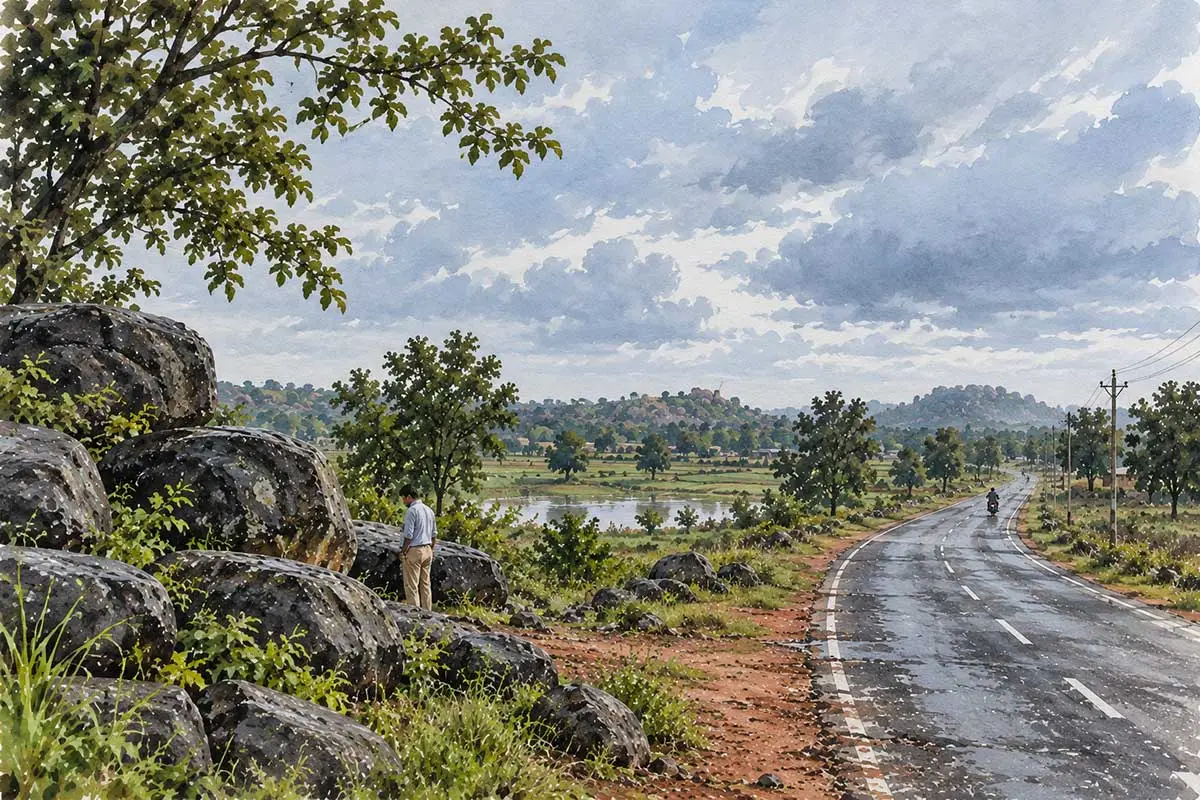
Negotiating a turn, we came across a clutch of precariously hung boulders. Shrubs and foliage clung for life in their crevices. I stopped the car next to them.
A few motorcycles sped past us. In the rear view mirror I saw a cycle-rider lumber over the slope. He looked at us as he passed and continued glancing back as he pedalled.
"What?" my wife asked.
"Nothing," I replied.
Getting down, I walked towards the rocks. From the boulders, my eyes drifted to the stone ballast jutting out along the roadside. Thousands more lie beneath the glistening coal tar surface.
“Time!”
As we drove into the night, twinkling lights lined up on both sides of the road. Cut outs of Devi Durga glimmered at regular intervals. Families in their shimmering dresses merrily walked, skirting puddles. When drizzle turned to downpour, they hurried under shops’ chajjas, waking the curled-up dogs. They craned their necks, surveyed the surroundings and huddled again.
Speakers at regular intervals blared music that filtered in through the rolled-up windows. As we moved towards it, the sound swelled and the car reverberated and our hearts pounded. It began receding soon after as the car moved away. Magenta and green lights shone over the pandals brimming with people. Chowmein and burger sellers, sandwiched between chat and samosa carts, had men, women and children rubbing shoulders under their awnings.
Hands folded. Heads bowed before the Goddess. Children hurried through their worship, waiting impatiently for their parents to complete their prayers.
Soon we were at Saraiyahaat. Had it not been for the pooja decorations, the darkness would have swallowed the road to Shumbheshwar Nath on our left. A black chadar — a sheet of darkness — had covered the field that throbbed with haggling buyers and sellers at the hatia. No one waited. Even dogs did not bark.
“Do you remember your excitement buying vegetables here?” I said to my wife.
“Hmm.” She kept looking at the blackness.
“The women selling tadi to the men had turned coy as I pointed my camera at them,” I said to my daughters. “But a few had smiled. I noticed it only when I was processing the images.”
The shack on the right — where we had snacked on moorhi-ghughni and aloo-chop in donas — was closed.
The entire kasba seemed oblivious to our passing car.
“Fourteen hundred kilometres is a long drive,” I mumbled.
Beyond the headlights, the road and the night had become one. The rain had stopped and the wipers did not whoosh. There was no sound except the engine’s gentle thrum. Every now and then, I thought I heard toads croak. Sometimes, they were joined by cicadas. It was a rhythm in which silence had long loops. Occasionally, from the rear seat, I would hear our daughters munch their chips — crunch-crunch.
“Twenty for ten rupees?” Well, I need to count the chips.
“Besides, you could not haggle.”