
As Ravan, the ten-headed demon king of Lanka (present Sri Lanka), started urinating, a gleeful expression filled his ten faces. His aeon-long penance at the foothills of the mythical Mount Kailash, the abode of Lord Shiva in the Himalayas, had borne the result. Not only the fiery God appeared before him, but also, as a boon, agreed to live with him in his kingdom. ‘And with Shiva on my side,’ Ravan thought while surveying the landscape, which his discharge had turned into a pond, ‘I would become invincible!’
Wading my way through the labyrinth of pilgrims, after a 20-hour train journey from Delhi, an orange carpet of human bodies, it seemed, had laid at the Jasidih Railway Station. They had captured every nook of the platform, every shed and anything with a roof, spending the night at the nearest railhead for Deoghar, the site of megalomaniac Ravan’s legendary pee. After another 4 km of a bone-crushing jeep ride, I was in the centre of the town. Nearby at the chowk (intersection), a clock tower stood listlessly. Its two arms were stuck in a time that no one paid heed to.
Shrill loudspeakers blared devotional Bhojpuri (a popular dialect from Bihar) songs. One of which has Lord Shiva beseeching his wife, Goddess Parvati, to prepare his daily quota of hemp (Cannabis sativa). Shops lined up on both sides of the road. A row of temporary stalls selling trinkets and souvenirs had come up bang in the centre. The business was brisk.
Music. A cacophony. A public display of faith.
Descending like locusts upon the alleys and the lanes, the orange-shirters, filled every corner, blanketing anything that came their way. Occasionally, shrill chants of Bol Bum (Hail the Lord’s Army) would rend the air.
A spectacle was unfolding. Joyous. Wild. Pious. Raucous.
Erstwhile bhadralok
Baidyanathdham Deoghar had geared itself to what is considered “the world’s longest fair,” eclipsing everything, including its past and its illustrious associations, in which Bengali bhadralok or gentility played vital roles.
One renowned figure was Aurobindo Ghosh. Belonging to a Bengali zamindar family and a firebrand nationalist, he lived in one of the sprawling (now crumbling) mansions and practised lobbing bombs at nearby Digaria Hill in an attempt to overthrow British rule. Another, Ishwar Chandra Vidyasagar, a pre-independent India social reformer working for women’s emancipation, established his ashram at an eponymous place called Vidyasagar, 34 km away. Then it has Goradih, a nondescript village on the outskirts of the town, where the British hanged sepoys when they had mutinied in 1857, during India’s first war of independence.
Trundling with the melee as an insignificant speck, the path gets narrower until, after about one kilometre, it branches into one of the numerous narrow alleys taking devotees inside the temple. Even otherwise, the lane, running adjacent to a drain, is claustrophobic, and for one month, when kanvariyas, as these orange-robed Shiva devotees are called, take over the town, it turns suffocating.
A long barefoot walk
For the kanvariyas, it has been a long journey. A much-awaited end to an arduous 108 km barefoot walk from Sultanganj, where they had collected the sacred water of the Holy Ganga, carried it on a wooden sling (Kanvar) over their shoulder to pour it on the Lingam—Shiva’s phallic form—in the act of gratitude and submission, and to extract boons, at Deoghar.
Though Lord Shiva is known for his fierce temper, he is also among the most venerated Gods of the Hindu pantheon, someone who could be easily placated. Devotees believe that during the Hindu month of Shravan (mid-July to mid-August), he is in an especially benevolent mood. Therefore, making it the right time for His devotees to implore him to free them from their miseries.
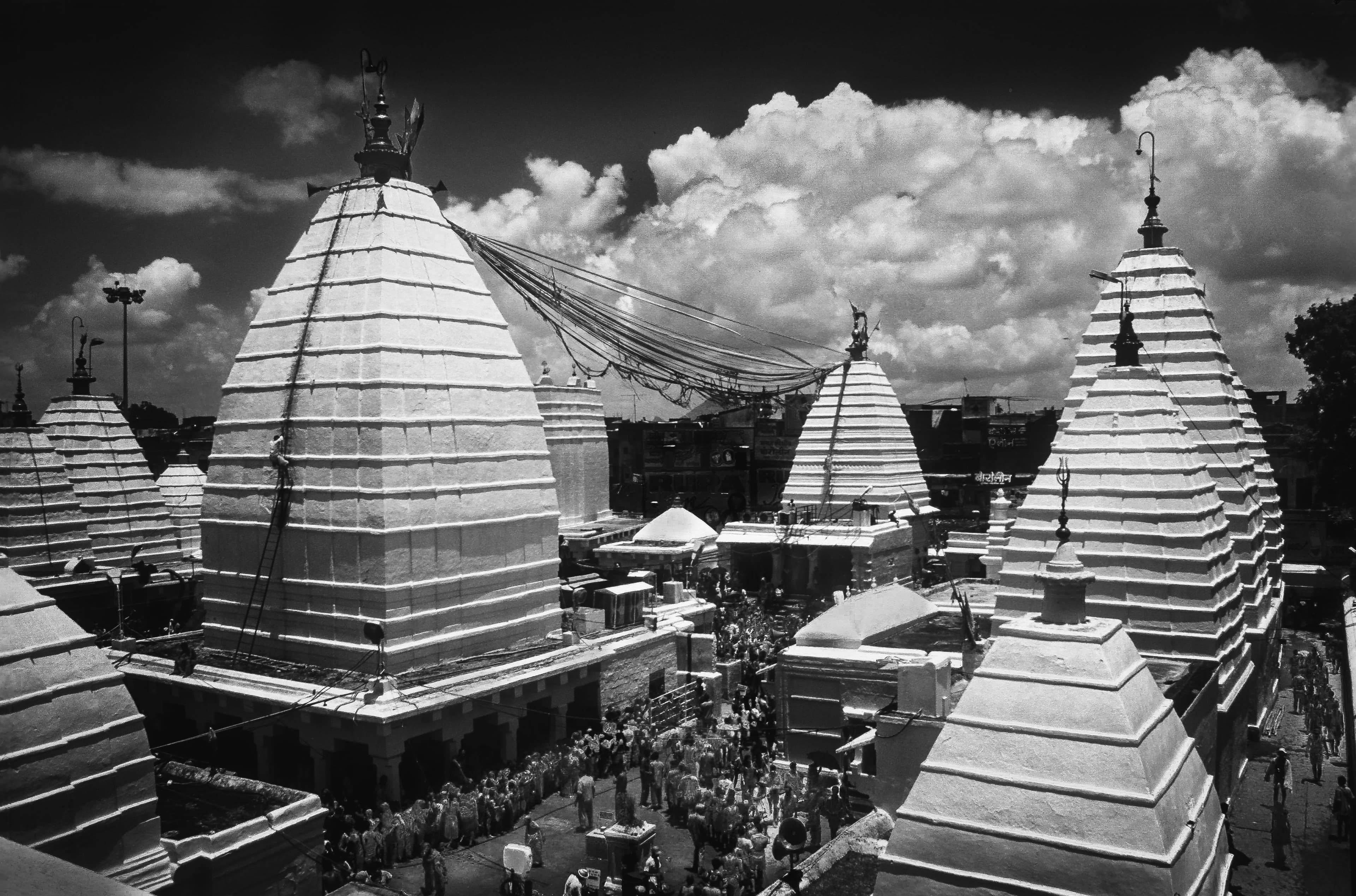
It is difficult to remain an atheist at the temple, comprising twenty-two other shrines. Maintaining order is an ordeal. Even the charges of frayed bamboo sticks by the police do little to deter the frenzied mob.
‘No duty could be as tough,’ says Awadhesh Kumar Singh, Inspector of Police. ‘We change personnel every 30 minutes.’
As the numbers can go over a lakh on any day, it takes a thorough crowd-control plan and an extra dose of good luck to avoid mishaps. (In one of the worst cases of a stampede, 11 persons died, and 50 were injured. That was in the year 2015.)
With only one low-height door, both for entrance and exit, it takes a giant leap of faith to enter the dimly lit tiny Sanctum Sanctorum.
Palms frantically reach out, jostling with other equally resolute arms to touch the Lord in a little burrow. Slippery floor, crushing bodies, shoving hands and banging heads, it is not a place for the sceptics.
‘It must be difficult for the Lord not to be overwhelmed by his devotees’ expectations!’
I am reminded of Bruce Almighty, the Hollywood movie on the woes of being God.
‘Lord Shiva wouldn’t have taken kindly to the gods, who, fearing Ravan’s wrath, first stole Him from the demon king and later deserted Him among mortals, who in turn do not follow the path He has enunciated and scramble up to Him when miseries strike them.’
Ravan is worsted
It reminds me of an incredulous tale told by one of the town’s residents, Shrikant Jha, about how the friction of the worshipping hands had eroded the original Lingam.
A retired Headmaster from Deoghar’s government school, he further informs me that the one in its place is a replica. Like the original Linga (the form in which Lord Shiva is worshipped), even this one barely peeps out after the disheartened Ravan had shoved it inside the earth.
Myths often assume gargantuan proportions, but at Baidyanath Temple in Deoghar, touted as the cultural capital of Jharkhand State and a Dwadash Jyotirlinga (one of the twelve most sacred Shiva temples spread all over India), it reaches a crescendo.
Having worsted Gods on innumerable occasions, Ravan was a formidable power. Therefore, when they knew of Shiva’s boon, which would increase the demon king’s strength manifold, they panicked. Fearing annihilation, the Gods, under the guidance of Lord Vishnu, one of the trinities in the Hindu pantheon assigned the role of a Preserver, devised a tactic.
As Ravan moved ahead, he felt the urge to pass water. A while later, he had a feeling that his bladder would burst.
The first part of God’s stratagem was working.
Unable to hold himself, his eyes scanned the landscape.
Ravan was looking for someone to hold his Lord since Shiva following God’s plan had expressly prohibited him from keeping Him down upon the ground. That turned out to be his nemesis.
He found a shepherd. Handing over to him his Lord, he went to take the leak. As he eased himself, according to myths, for many years because Gods had routed a river through his tract, the shepherd, none other than Lord Vishnu, walked a little distance, kept Shiva on the ground, and ran away.
When Ravan returned, he seethed with anger but could not do anything.
All his pleadings fell on deaf ears.
‘I will not budge an inch,’ Shiva reminded him, ‘I had warned you.’
The pond from the temple is about 4 km away at a place called Harlajodi. Surrounded by green paddy fields in a lush countryside—could Ravan have a role in enhancing fertility?—the sight turns out to be an ante-thesis of this epical journey.
‘Are you sure this is it?’ I ask five kids on whose directions I negotiate the dirt track, skirting excrements.
They nod in unison.
Emerging from the thicket, what confronted me barely resembled a poodle. Fed by a seasonal brook, it hardly had any water, and every wee bit of it was shorn of its mythical grandeur.
‘Ravan’s ten heads,’ I wonder, ‘if they are still down in disgust!’
(2001)