
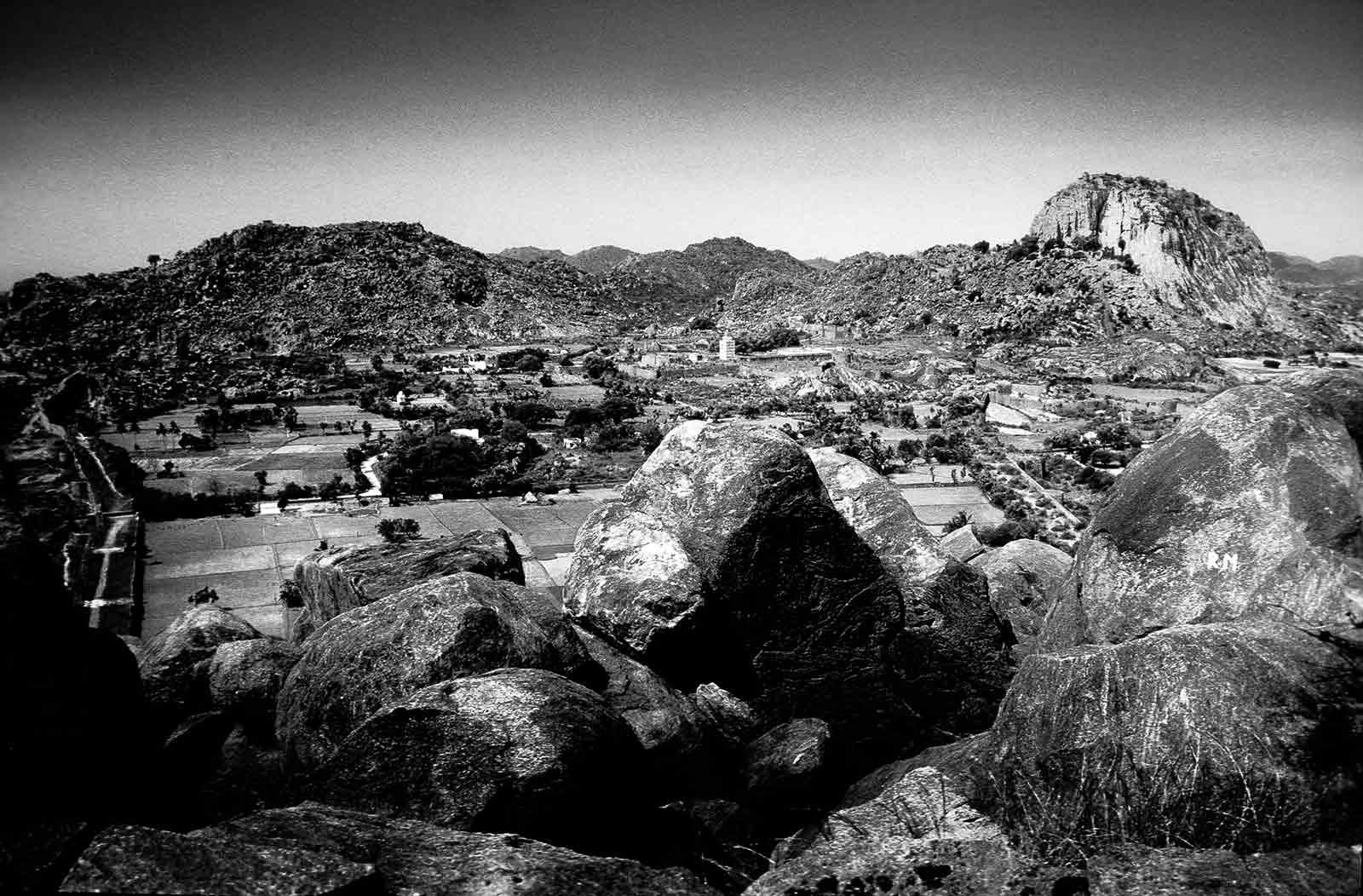
Sitting tired on an uneven granite step halfway to the battlements at Krishnagiri in Gingee, I felt horrible. The May summer equatorial sun was searing and pierced into my head.
I was sweating profusely. Dehydrated, every now and then, my intestines rumbled, and I felt I would throw up.
With water down to the last drop, I wished the ordeal to get over. I would leave the town at once. So much for the place that had consumed my mind, body and soul since I read about it a few months ago.
Father Pimenta, a Portuguese Jesuit visiting Gingee in 1597, had dubbed it “Troy of the East.” So overawed he was by the sight that he called Gingee “the greatest city he had seen in India, bigger than any in Portugal, except Lisbon.”
I had arrived from Pondicherry (renamed Puducherry), 70 km, by bus the night before. Finding a place to stay wasn’t that difficult. Being a small town, Gingee didn’t offer much choice either. The first Taj Lodge, contrary to its name derived from the famous Mughal mausoleum, the Taj Mahal at Agra, turned out to be a ghetto. The next, Hotel Sivasand, was decent.
Too tired to venture out into the town to look for an eatery for the region’s popular idli, dosa or utthapam dinner, I opt for the hotel’s non-vegetarian restaurant. As the waiter presented the menu in a dimly lit bamboo environment, it whetted my appetite.
I order fish fry. And regretted as soon as it arrived.
They were greasy and reeked of coconut oil, the primary cooking medium in South India, unpalatable for my North Indian tongue. Fatigued and famished, it was close to midnight, and with no other option, I ate and prayed.
Leaving the bed in the morning, I was glad to find that my stomach had withstood the onslaught. Light breakfast and a glass of fine steamed tea at the bus stand, I was soon walking towards Krishnagiri.
Tale of hill fortresses
Three inaccessible boulder-strewn hill forts, Krishnagiri, Chakkilidurg and Rajagiri, forming a triangle 3 km away, dominate the landscape. Almost 160 km southwest of Chennai (formerly Madras) in the state of Tamil Nadu, they are enclosed within a 45-foot-thick rampart and protected by an 80-foot wide moat. At the top, it has temples, some rudimentary residential quarters and a couple of huge granaries.
But at Gingee, it is not the architecture that is fascinating. Rather, it was the location that held one spellbound. A craggy spectacle, broken intermittently by green paddy fields on one side and Muthakadu Forest Reserve on the other, what amazes everyone is how Ananda Kone in CE 1200 could even think of fortifying them. Perhaps it was a strategic move.
The location is such that control over Gingee was fiercely contested. It has often changed hands and included, among others, the Mughals and the Marathas at different points in time. With the arrival of the European trading companies, the contest turned even more fierce. The French occupied it first. But when the English decisively defeated them, they surrendered it in 1761.
The gradient is steep. The steps are uneven. To lay them must have been a Herculean task. Hanging precariously on one another, it appears as if a “Goliath” had played with these “granite pebbles” and left them without arranging when he was fed up. Even the slightest tremor, it seemed, would set the rocks tumbling down.
Spectacular Rajagiri
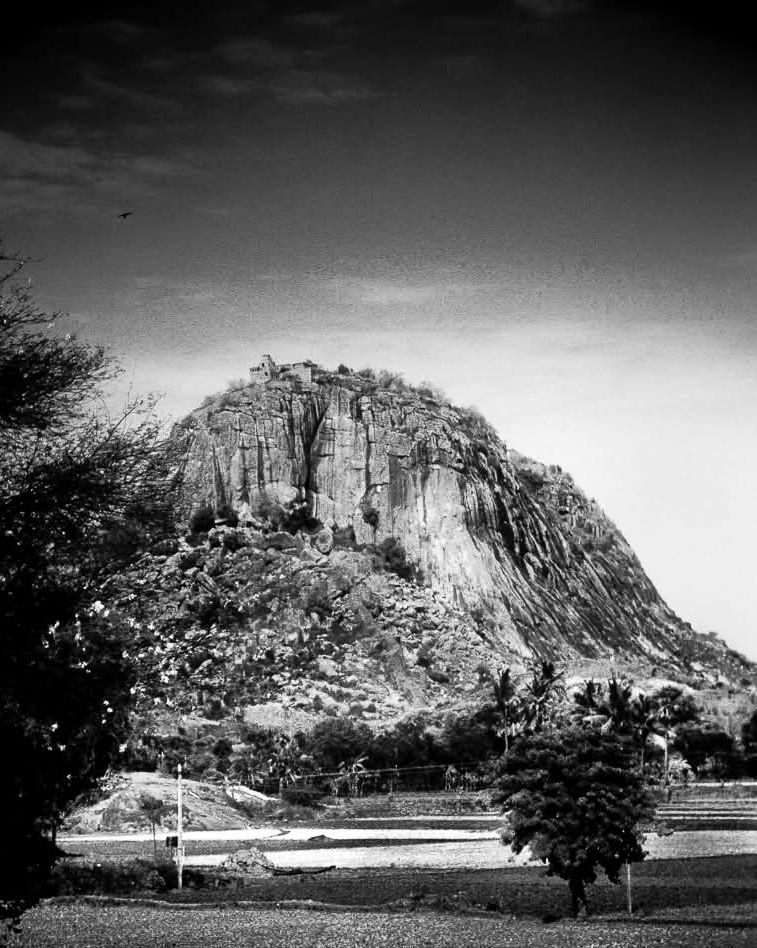
The most spectacular of the three is Rajagiri, at some distance. It is an unusual sight—one massive boulder that juts out from its craggy brethren almost midway and seems to be touching the sky.
As I size up the hill, yearningly, aware that I won’t be able to scale it, I wonder how fortifications atop this boulder have been constructed. The sides are straight and smooth. Except for rock climbing, one could not have reached the top. Gingee had been planned to withstand long sieges.
And here I was in the middle of such an incredible location feeling utterly hopeless. Dinner the previous night was taking its toll at 11 the next day. There was a strong urge to pass stool.
Throat had become parched. Coolness was also enveloping my body, and my head tingled. I felt I was about to faint. With all hopes down, I prayed for a miracle.
Gingee can wait for the next time.
Minutes earlier, a family eyeing me with concern had walked past me. Except for their excited voices at the top, there were not many people. Only monkeys prattled around. After about an hour, they return. I was still sitting there. Feebly, I request them for tanni, water as it is called in the local Tamil language. The man answers back.
‘Tamil ille, I don’t know Tamil.’ I reply. To which he shows me his empty bottle. They are concerned, but the language forestalls conversation. After a while, they leave.
Sometime later, I see the man again. He clambered, huffing and puffing, with a young boy, his son, in tow. From some distance, the father points his fingers towards me, and the kid runs right up to me. He clenched the same bottle that the man had shown me earlier. But this time, it was filled to the brim.
The boy poured the water from his bottle into mine. I mumble thanks and nod my head at him and the man ten metres below and drink. As the elixir gurgled down my throat, it was warm. It didn’t quench my thirst. But some time later, a miracle happened.
I felt fit, hale and hearty again.
So much so that instead of climbing down, I went up, and after exploring Krishnagiri, even huffed and puffed to be at the top of the mighty Rajagiri.
Gingee can’t wait.