
"Want rooms?" The tout latched on to me as soon as I alighted from the bus at Mahabalipuram (at present called Mamallapuram).
"Sea facing! Very cheap!" he blurted out a ridiculously low amount.
I was tempted, I must confess, but, not wanting to repeat my Agra experience, dismissed him derisively.
That was in the early 90s. We were a bunch of friends, rookies in college, and, picking up an assortment of two-wheelers, rode all the way from Delhi to Agra. Looking for accommodation that would be a little on the low side, we had checked into this particular hotel promised by the agent not just to be singularly affordable but also, amongst other things, a reinvigorating, round-the-clock view of the Taj Mahal.
Checking into the dingy room after completing the payment formalities, even though we hadn't entered the precincts with any high hopes, but running over the dust-laden walls, dilapidated houses and dishevelled streets, when our eyes finally settled on the meagre curve of the glistening marble dome and the spire in the backdrop of the rumbling sky, even after discounting the hard sell, it was not even one per cent of the term tantalising.
Hooked
The rains of the night before had turned the pothole-filled main road into a tarmac of cesspools—one nook of which was occupied by the bus stand. Filled with sweating bodies seeking reprieve from the singeing equatorial sun, the shed, impenetrable to the fiery light overhead in the sky, looked like a gouged eye socket hunkering for respite.
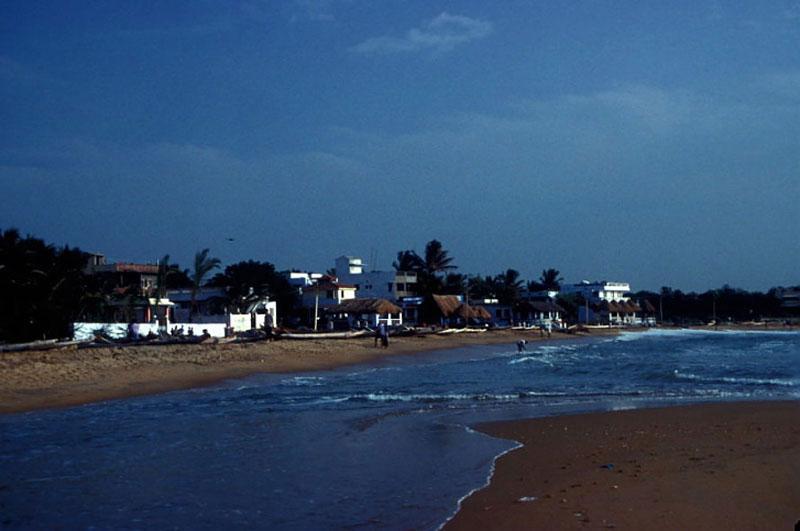
From the centre of the town, roughly coterminous with where I stood, the major monuments were within a 10-minute walking distance. "With a few non-descript places to stay," I had found out while devouring the Lonely Planet guide, "that's where I had wanted to put up."
"Ours is a highly popular hotel among foreigners."
Delivered as a last-ditch attempt, his statement struck me as a bolt from the blue. Unheard of, unread anywhere, his well-rehearsed winning pitch overpowered me and, as my mind gave up its resistance, it watched itself caught in the snare of a voyeur.
Taking a seat by his side in an auto-rickshaw—which he lost no time in hailing—its grunt amplified by the narrow cemented alley weaving through the outer walls of the houses, it bared a world far removed from the splendour of the temple architecture, which represented the first stage in the development of the monolithic Dravidian style with its signature tall Gopurams (gateways). The majority of the population derived their livelihood from fishing and were poor.
"The road," breaking the awkward silence, forestalled by the lack of ability to speak each other's mother tongue—that is, Tamil for him and Hindi in my case—he informed me, "is a short-cut."
Another approach from the main market side is littered with restaurants and kiosks enticing foreign visitors with souvenirs and flapping cotton pyjamas and tops, which they prefer to flutter around in in the oppressive heat. Indian travellers, who opt for a day trip from Chennai, 60 km away, seldom stay overnight and hence do not count much for the town's sustenance.
Dazed
Even otherwise, Mahabalipuram is, at best, a one-day town—two at the most, if you really want to stretch it. But if you have other interests, local life or sculptures, for example, or if you desire to explore India's 'high' like many who lodge here, then lodgings in the cheap seaside fishing village are what you should get.
I find it strange that most of the spots in India that have turned out to be high-decibel locations are also places where grass, marijuana, hash or pot, call it by any name, are easily available. Khajuraho, Goa, Dharamshala, Pushkar, Manali, Mahabalipuram.
Entering the hotel, sultry with a tang of weed and beer and whiskey and rum, the tout unhinges himself and leaves me with the Tamil manager, who is fluent in English, German and French. While he jots down my particulars, the gilded certificates of recommendations by Lonely Planet and others hanging on the wall, recently white-washed at the opposite end of his tiny reception, draw me towards them, and, answering in monosyllables, I chuckle that I had made a choice I won't regret.
The hotel dons a neat look. Its sparse ambience imparts it a charm better than what I had expected at the price. Though a bit haphazard in construction—perhaps it was a house hastily converted into a hotel to cash in on the Mahabalipuram craze—it felt cosy. And homely.
Led by the boy, climbing two flights of constricted, steep stairs, I make my way carefully, skirting foreigners squatting on the floor in the narrow passage overlooking a courtyard, wearing the bare minimum to beat the oppressive heat and humidity, their backs against the doors, both men and women, some still in a daze at 3 in the evening.
Waves
They greet me with a smile and a slow nod of the head as I tread carefully on the slippery floor to my room on the first floor. Watching their attire, a motley blend of gaudily coloured lungi (sarong), shorts, vests and unbuttoned shirts, makes me conscious of what I wear and makes me feel as if I were a man who, not long ago, had landed from Mars.
"I shouldn't have come," I brood, sitting inside my Spartan accommodation while taking stock of my place. Perhaps I am overwhelmed and do not take the thought further. Diverting my attention towards the sea, I am glad that I can not only hear the Bay of Bengal's roaring waves and watch it embracing the sky from the rooftop dining area, but also take consolation in the fact that the beach is hardly 50 metres away from the back door.
After a hurried cup of tea, I make haste towards the coast. Hundreds of wooden boats are moored at the shore. Hundreds are out in the sea, having set off early in the morning for fishing's never-ending grind, and will return when the sun, the sea and the sky, basking in each other's arms, spread a deceitful romantic aura, silhouetting their skiffs in an orangish-red glow. Among the few fishermen who do not venture out, some are engaged in the laborious task of mending their nylon nets.
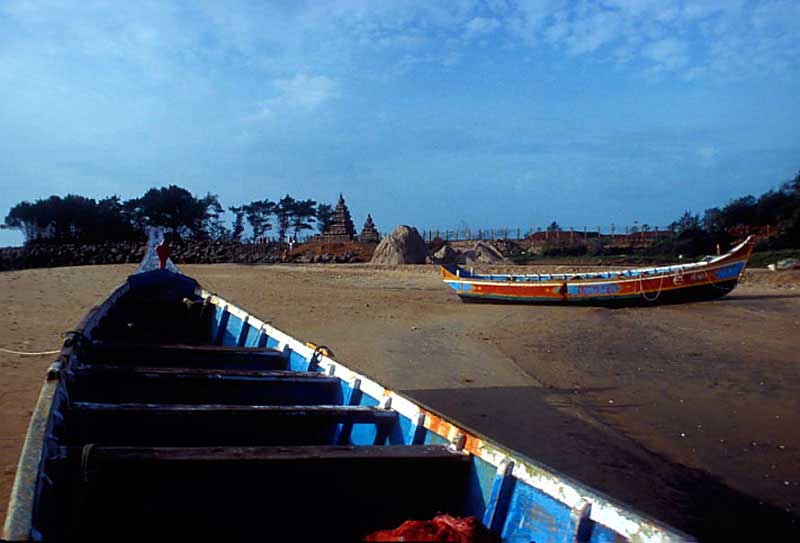
On my right, at the far end, a stone-and-mud embankment juts out into the sea. Breaking the waves to prevent the lashing ocean currents from eating into the foundation of the AD 8th-century Shore Temple, which, along with the Kailashnath Temple at Kanchipuram, occupies the pinnacle of the architectural aspirations of the Pallavas, a c. 8th-century dynasty of prolific temple builders in South India, their realm roughly coterminous with present-day Tamil Nadu.
Stones
Situated at the mouth of the now bone-dry Palar River, where it pours into the Bay of Bengal, Mahabalipuram, during the Pallava reign, is an important trading centre and a seaport from where ships, apart from engaging in robust trade with Southeast Asia, also export much of the Hindu and Buddhist influences in the region—Kalaripayattu, a traditional martial art from Kerala that blossomed into karate in the Far East, for example.
Commerce brings them riches, which buy them leisure, and as the eyes of the ambitious Pallavas fall on the vast expanse of low-lying granite hills, it whets their creativity and ignites their passion, which finds expression in free-standing rock architecture.
Cleaving their first independent rock temples, apart from gouging others into the hills, the Pallava artisans, chiselling from top to bottom, carve what now counts as the masterpieces of world architecture and a UNESCO World Heritage Site.
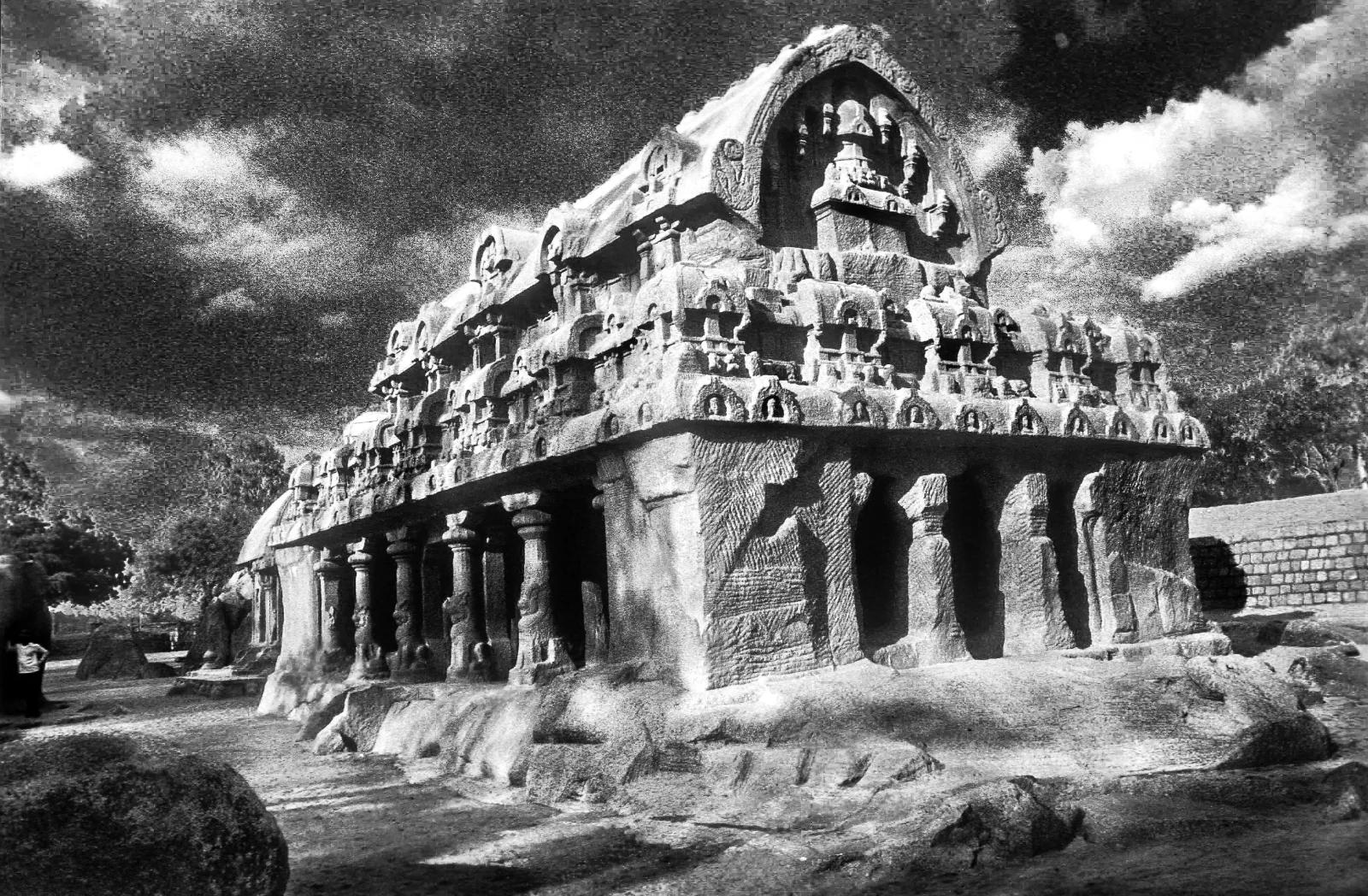
Shore Temple, Panch Rath Temple and Arjuna's Penance are among the notable rock-hewn edifices.
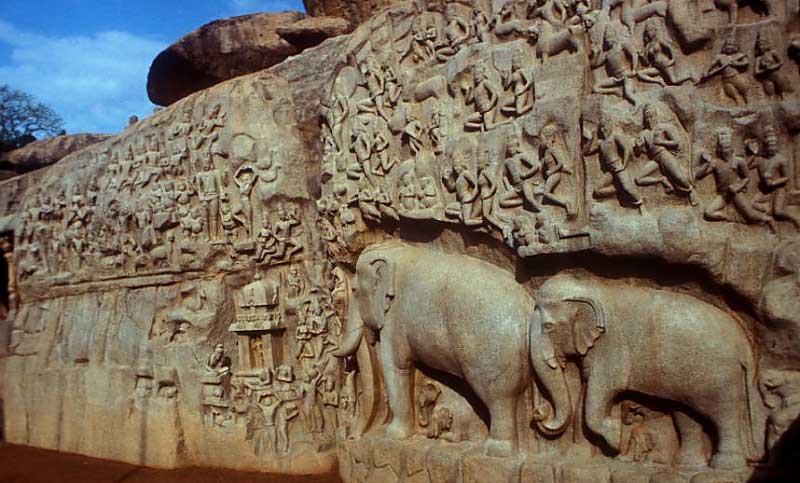
Measuring 27 m × 9 m, Arjuna's Penance is the world's largest bas-relief. In its effort to showcase the creation, it features gods, demi-gods, men, beasts and birds, including a meditating cat worshipped by rats at its feet.
Panch Rath—five chariots in English—is a group of monolithic temples, each one cleaved in a different style.
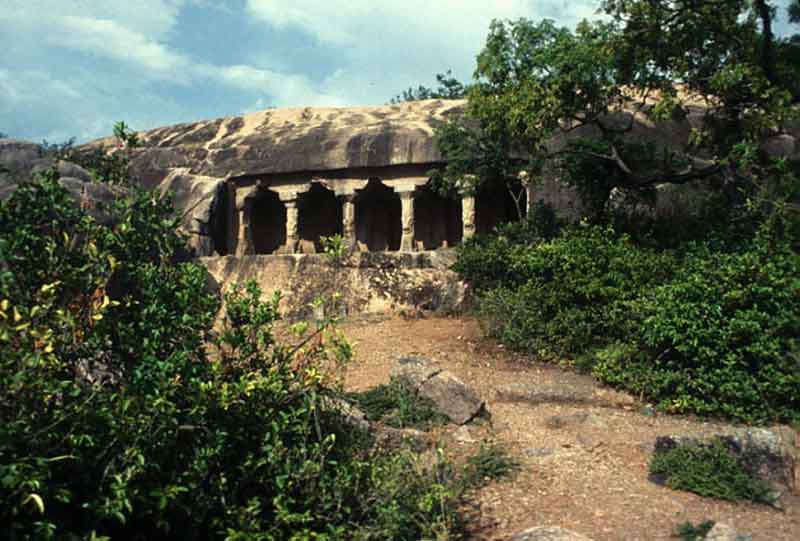
Various cave shrines, including the Mahisasurmardini and Varaha temples, occupy the hillock close to the bus stand. A lighthouse at the top provides a splendid view of the countryside, but photography, since it is located in the vicinity of the Kalpakkam nuclear plant, is not permitted.
Stoned
Walking on the ridge past Krishna's Butterball, a precariously perched monolithic granite sphere that God knows why does not tumble down, a raucous laughter and gay conversation lead me towards a clump of trees at its foot. As I get closer, tiptoeing over shards of beer, whiskey and rum bottles, a strong waft of marijuana hits me. The language is accented and in English.
Later, talking to one of the uniformed ASI guards, Nagendra, he is at pains to explain. "Every time I smell something fishy, I drive them out. But every other moment they return." He speaks with a mien that is both hurt and amused. "It's a large area that I can't be present everywhere."
As I leave, thanking him for the cold drink—he turns out to be from my hometown and insists on being hospitable—he adds, "You won't believe! They stay here like this for months together."