
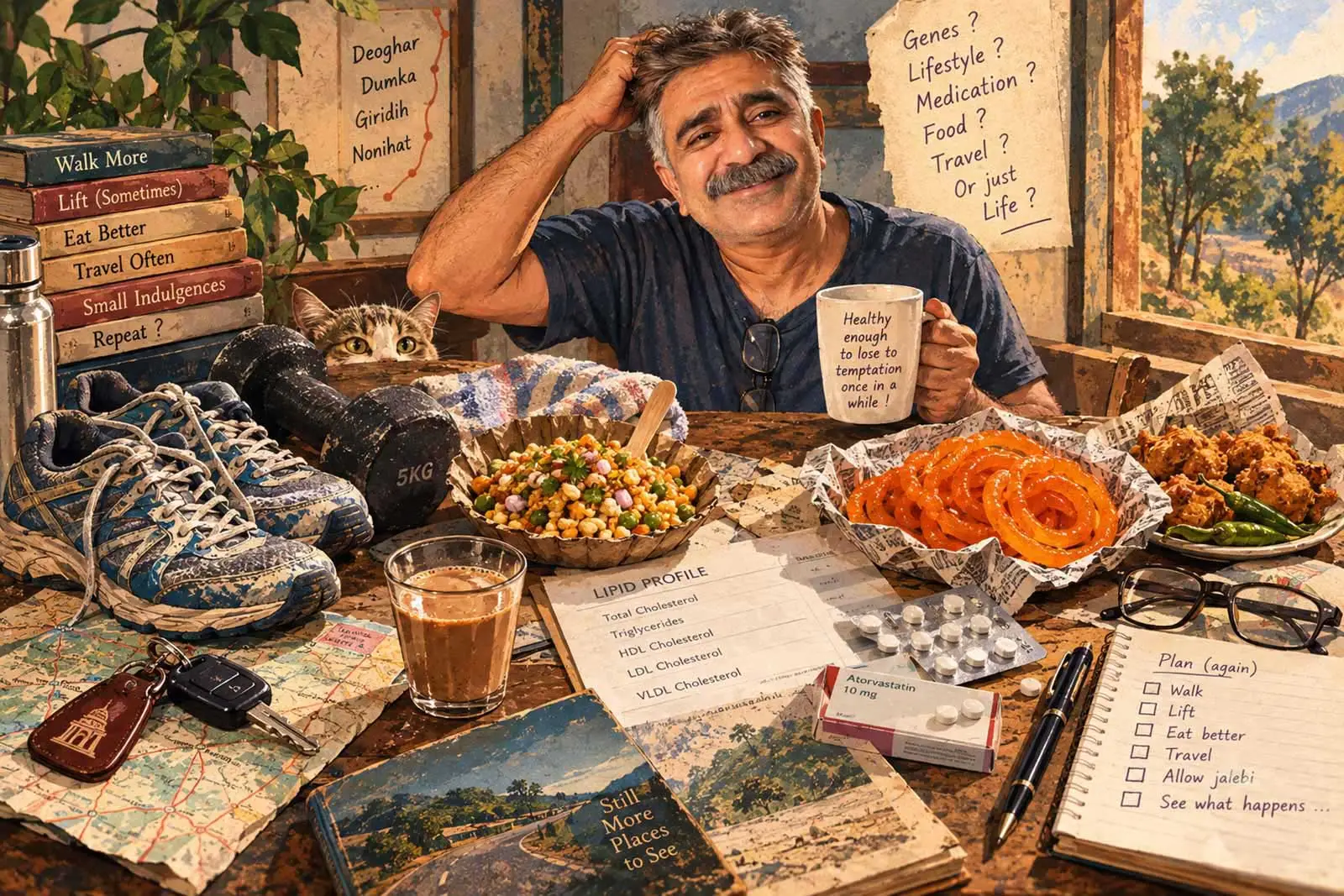
The blood report had just landed on my phone.
Triglycerides.
563.
I zoomed in.
The number did not change.
Immediately, I called another lab and booked a retest for the next morning.
The report arrived the following evening.
Zooming in this time changed the number.
206.
Even though borderline high, it was at par with the level 12 years ago, and every other report since then.
I was in my early forties then. While the physician recommended brisk walking and avoiding fried foods and sweets, I blamed it on my family history.
My father’s cholesterol exceeded the limit by many notches. His brothers’ were even higher.
“I was weight training and running.”
“At the peak of my health.”
“Nothing could’ve brought it down.”
I confronted the first lab with the number. They stood by it.
It was an acquaintance of more than 10 years. My wife, my daughter, my father, my mother and I — our livers, kidneys, cholesterols, triglycerides, haemoglobins, thyroids and countless other markers in the blood had spoken through him.
The mismatch puzzled him. “We had even conducted a retest,” he said and read the note on the fasting period in the report and paused. “It requires at least 10 hours,” he continued. “Maybe that’s the issue.”
In my case, the gap was roughly eight hours.
Maybe.
Armed with both reports as well as all the numbers over the last 12 years, I did not go to my regular doctor.
I was not sure why.
Perhaps I wanted them to be seen through new eyes.
Weight checked. BP checked. SpO2 level checked. The lady at the desk asked me whether I had fever. I said no.
As I sat in the waiting room I wondered whether he would agree or disagree with me.
The receptionist announced my name.
“Namaskar,” I said and sat on the chair in front of him. A transparent plexiglass partition, a reminder of COVID’s uncertainty, separated us. From a cut-out beneath the screen, I passed the paper on which he would write his prescription. At the top were the two contrasting reports.
He quickly scanned both reports.
“Hmmm!” and prescribed a 10 mg combination of Rosuvastatin and Fenofibrate for one month.
“But Sir,” I slid another sheaf of papers towards him, sheets neatly turned to reflect the cholesterol figures, and pointed to the lipid numbers over the years, “I think it could be genetics.”
“Walk at a brisk pace for 45 minutes daily, do not eat oily foods and no sweets,” he said as he completed the prescription.
“I wonder if he understood me,” I mumbled as I left the clinic.
A few days later, packing strips of tablets in my bag, we left home for Durga Puja.
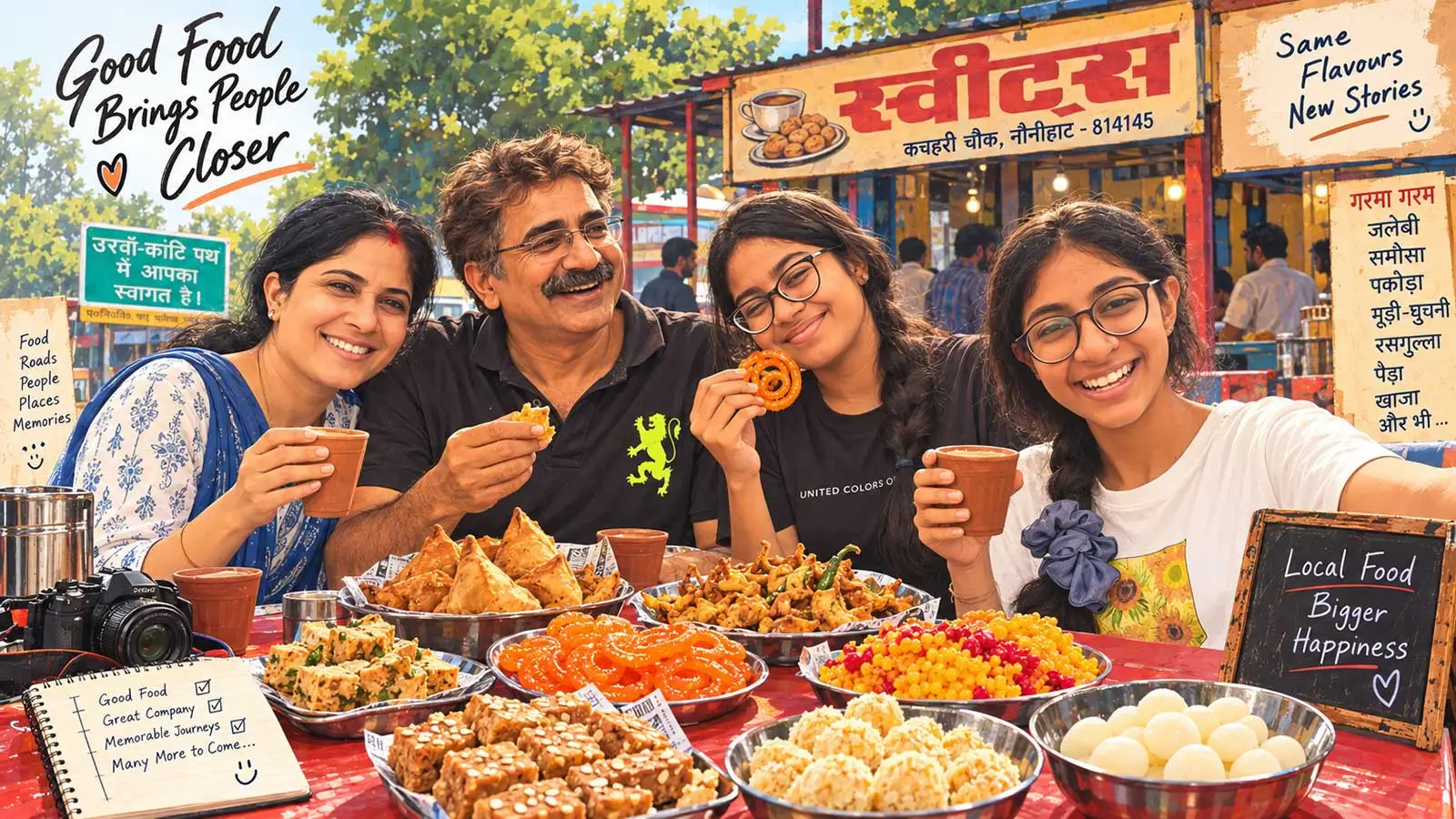
“It’s going to be a sumptuous vacation,” we told ourselves as we nibbled hot pakoras at a roadside shack in Bengabad just past Giridih in Jharkhand on the second day of our 1,300 km drive. Our daughters wanted more.
“Then go and order for yourself, and for me,” I winked.
“For me as well,” my wife said.
“The brinjals are freshly plucked,” I said. “Get me two more. They are vegetables after all,” and we all laughed.
“The aloo-chop,” our elder daughter chirped, “why don’t we get mashed potatoes to taste like this!”
The younger daughter nodded.
Peda in Ghormara. Raskadam in Dhumka. Moorhi-gughni in Nonihat. Atthe in Deoghar.
And tea, made from milk simmering non-stop on low heat, a flavour called ‘sondha’ locally. The cream skimmed from the top turned into another delicacy — ‘chhali’.
For the next six days, as we travelled in the region where we had grown up, every stop, every snack brought back a memory.
“These places mattered only to the people who lived there,” my wife recalled.
“Snacking was something you relished, not wrote about,” I added.
Our daughters listened attentively. They wanted more such stories and even more of the snacks.
“Why does everything tasty have to be carbs, fat and sugar?” I asked.
My wife, as she returned with a dona of moorhi-ghughni in one hand and aloo-chop in the other, gave me a look and we laughed.
Returning home, I was one kg heavier. The medicine too was over, and I was 10 days late with my lipid test.
When the results came, triglycerides, LDL, and HDL levels remained where they always had been.
“Genetics,” I said to myself.
“He is not pleased with me,” I thought as the doctor scanned the report. “We had gone on a holiday. I did not walk and did not watch my food,” I said.
“Continue the same treatment.” He wrote. “For 60 days. And a lipid profile at the end of it.”
“And get the test while you are still taking the tablet,” he added. “No gap.”
“Walk. Avoid fried food. Avoid sweets.” The advice I had heard so often over the years that it had refused to make a dent in my head.
But this time it was different.
Except during winter, for most of the year I had been in the gym at least 3 days a week. The number on the weighing scale had come down. Inches had also come off my waist.
Then it stalled.
Brisk walking could be the answer. Everyone talked about it. Even my doctor.
It was early November. Dense fog was on the anvil.
Leaving the quilt while it was dark was torture. “Sleep late tomorrow. It’s your rest day.”
Evenings had their own set of challenges.
First was pollution. The doctor had asked me to walk indoors. Instead, I chose a mask. It made me sweaty, and the moisture from the warm breath irritated my throat.
Second, it was the cold. By the time the warmth dispersed the chill that pierced my palms and face, I was in the last leg of the walk.
It was a pleasant winter morning. January. Fourth day of the new year.
The regular technician wasn’t there. The owner had tried, but the veins slipped the needle.
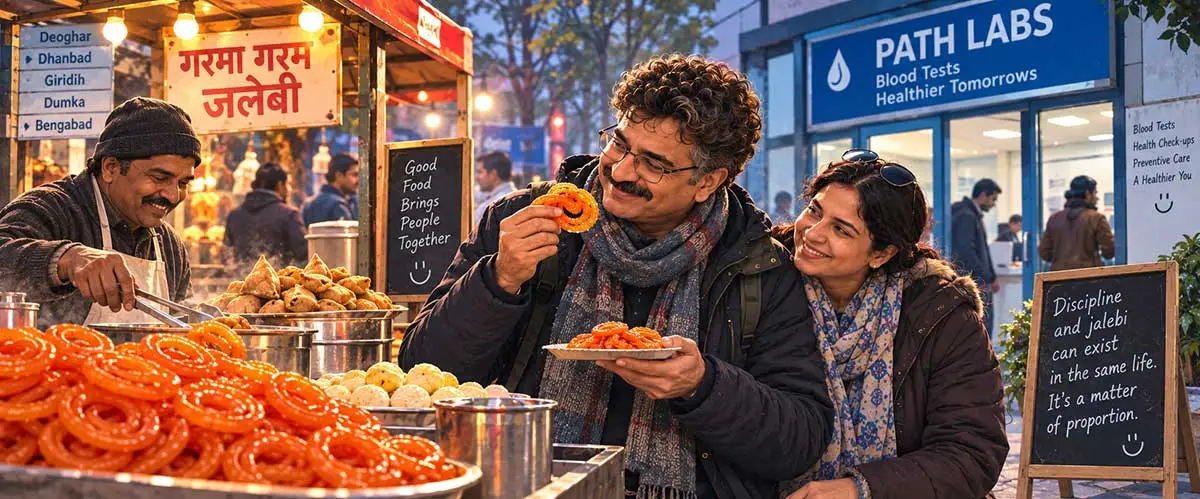
As we warmed up in the sun, the aroma of jalebis being made in pure ghee in the sweet shop next to the lab made my mouth water.
“We will buy a few hundred grams after the test,” I said to my wife.
“I don’t think we will,” she replied.
“Only today,” I said. “I need to treat my effort.”
That sealed the argument.
The next day, the report was on WhatsApp.
Total cholesterol – 122. Non-HDL Cholesterol – 78. LDL Cholesterol – 65. And Triglycerides – 63.
The medication had done its work. But the doctor wasn’t done yet.
As he went through the report, he smiled.
“Your weight has come down,” he remarked, and reduced the dose to 5 mg. “Take it every other day for two months, and a lipid test at the end of it,” he added.
Two birthdays and a wedding anniversary. In one month.
“Two cakes on each occasion,” our daughters planned.
“We will use premium icing,” I joined them.
“One of them will be a chocolate truffle cake,” my wife added.
“And the other a blueberry,” I intervened. “I really like its tanginess.”
“Yummy,” the younger daughter exclaimed. “Decadent.”
The lipids at the end of two months (beginning of March) remained good. As the doctor went through the report, he smiled again.
Pleased not only with himself, but perhaps also with his patient who had followed his advice.
“I am stopping your medicine,” he said. “Continue walking and see me in two months with another lipid profile.”
“Thank you, sir.”
The doctor nodded, and I loped out of his cabin.
Now it was entirely up to me.
But life.
I was fed up trying to manage time to exercise in the morning and walk in the evening. My younger daughter’s tenth board exams were also on, and I had to take her to, and bring her back from the centre, on the days she had her exam.
She wanted an ice cream after each paper. I also took one.
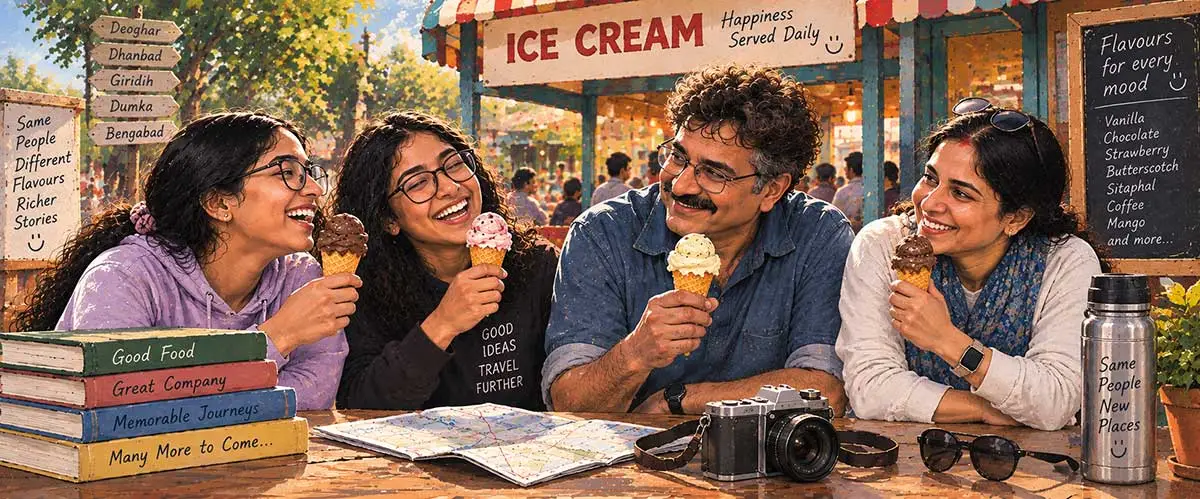
“I had to give her company!”
Once the routine began to settle, I had a GI tract infection. I thought it was a minor case. However, after 15 days, when it refused to subside, I went to the doctor. In ten days, I saw him twice. The medicines brought some relief, but the infection stayed.
After waiting for another week, I consulted another doctor. Same story. Two weeks gone. Still no relief.
Most mornings I would crawl out of bed to switch off the alarm.
"Just 30 minutes," I would tell myself and wake up only when it was time for the office.
The gym bag, which I had packed the night before, sat on the settee.
The shoes, strategically kept to save time, waited at the door.
In the evenings, after tea, when it was time for my walk, I would tell my wife, “I don't feel like it.”
She simply nodded.
I can still recall that day clearly. It was after the visit to the second doctor. I don’t know why, but I felt off. Taking out the car, I roamed aimlessly. I had also forgotten to take the ORS solution.
Remembering my mistake in the evening, I opened the fridge and took a swig. Then the second. It felt good. One more gulp. As the cool liquid gurgled down my throat, it acted like an elixir. By the time, I put the bottle back, I had guzzled around a glass and a half.
Almost immediately I experienced an urge. Another few minutes and my belly began to expand.
A quick Google search and I understood that I was taking the mixture well above the daily dose.
Slowly my condition began to improve, but for more than one month I had neither lifted weights nor walked, and I had lost two kilos.
Most importantly, my tests were already a fortnight due.
I set myself a target of weight training for five days and walking daily for 40–50 minutes.
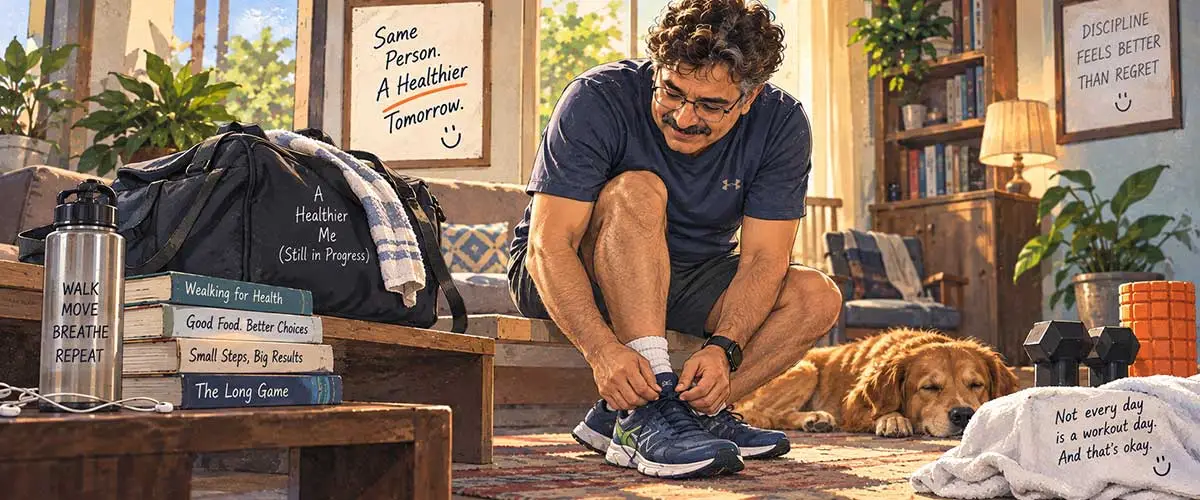
It was the end of May, and the temperature routinely crossed 40 degrees. The concrete pathway radiated heat.
Sweat would drip from the tip of my nose. I would constantly mop my face with my hanky.
My legs wanted to stop halfway.
I slowed down.
But did not stop.
One week in, postponing the test further was getting difficult. On Sunday I was at the lab.
“Did they carry traces of biryani or the sweetness of the rava kesar I had the day before at the Tamil Nadu Bhawan canteen?” I wondered as the paramedic drew my blood.
“Postpone it for another week,” a part of me said.
“But your blood should report how you actually live,” the other argued.
“That would help me finalise my future lifestyle,” and asked both of them to shut up.
Walking out of the collection centre, I could smell jalebis in the adjacent shop. I was reminded of their crunchy sweetness.
For a moment I was tempted.
“Not this time.”
I moved on.
That evening, I did not walk.
The lab had promised the report that night.
All through the evening, the phone remained in my sight. Every notification made me reach for it. I even got up from sleep, switched on the phone’s internet and waited in the darkness.
It dinged with a few messages, but not the one I waited for.
The next day we had a presentation.
A new pitch.
A new angle.
Last-minute changes.
Discussions with designers.
More revisions.
From one cabin to another.
At every notification, I reached for the phone — unlocked it, glanced at the message and got back to work.
11:45.
At last!
As I downloaded the PDF, my boss called my name.
I turned the phone in landscape mode.
The report rotated with it.
Scrolling down, I saw a few in bold, but I didn’t pause.
It was a nine-page report.
My fingers flitted.
Lipids!
Page 5.
I stopped.
Two were in bold.
I held my breath.
Triglycerides were not among them.
I took one long breath.
Returning home in the evening, I stopped at the clinic.
As I looked for a shade to park the car, I was not sure what the doctor would make of the numbers.
Triglycerides were well under the limit.
Non-HDL cholesterol and LDL cholesterol were just a little over.
Waiting for my turn after recording my vitals, I watched the fish in the aquarium. I wondered what they made of the world beyond the glass. The television above showed news. The anchor was muted.
As my eyes flitted between TV and fish, the receptionist called out my name.
Gathering the folder with the printouts of the report, I opened the door and stepped inside.
“Namaskar, sir.”
The doctor nodded and pointed in the direction of the chair.
There were two.
I took the one which was by the wall. From the cut-out, I slid the prescription and the report.
He leafed through the pages and stopped at the fifth.
“Under control,” he said.
“Anything serious, sir?”
“Nothing,” he replied and pushed the papers beneath the cut-out towards me.
He hadn’t written anything on the prescription.
“Thank you.”
He smiled. Slightly longer.
The engine sputtered to life. I waited for it to settle into a gentle hum before I shifted the car into forward gear.
The road ahead looked promising.
A red light, and I stopped.
Something still nagged me.
A number.
HDL cholesterol.
Whether I took medicine or not.
Whether I walked or not.
Whether I ate sweets or not.
Whether I weighed more or less.
It had remained unchanged.
The light turned green.
“Genetics,” I was reasonably sure.
I stepped on the accelerator.